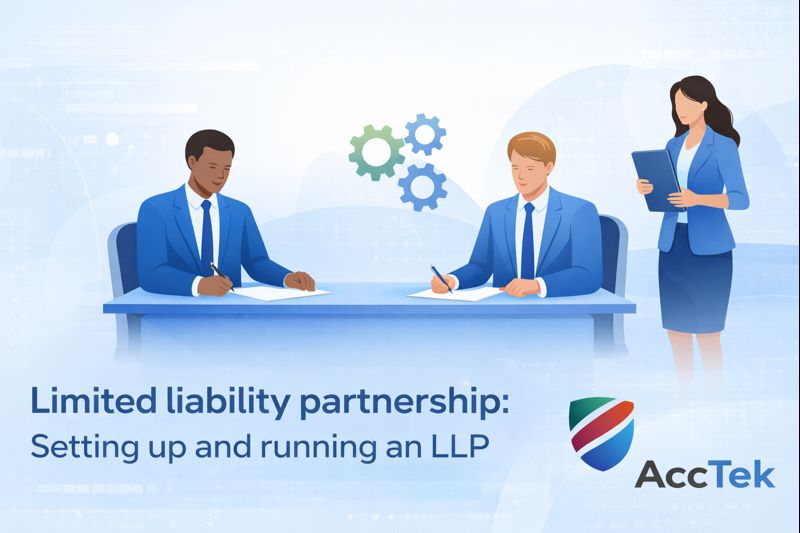
Hello there! I’m your friendly neighborhood Chartered Accountant, and today we are diving into one of my favorite “hybrid” business structures: the Limited Liability Partnership (LLP).
If a traditional partnership and a limited company had a baby, it would be an LLP. It’s got the “cool, flexible” vibe of a partnership but wears the “protective armor” of a limited company. Whether you’re a pair of architects, consultants, or even tech wizards, the LLP is a fantastic way to collaborate without betting your house on your partner’s decisions.
Let’s break down how to get this show on the road for the 2025/26 and 2026/27 tax years.
In a traditional partnership, if your partner accidentally buys 10,000 unicycles the business can’t afford, the creditors could come for your personal car. Yikes.
In an LLP, the entity is a “body corporate”. It can own property, sign contracts, and—most importantly—it has its own debts. Your liability is generally limited to what you’ve invested in the business.
To start an LLP, you need:
At least two members: These can be humans or even other companies.
Two “Designated Members”: Think of these as the “responsible adults” who handle the paperwork with Companies House.
An LLP Agreement: While not legally required to be filed, do not skip this. It’s the “prenup” for your business, deciding how profits are split and what happens if someone wants to leave.
You don’t just high-five and become an LLP; you have to register with Companies House.
Choose a Name: It must end in “Limited Liability Partnership” or “LLP”.
Registered Office: You need a physical UK address where HMRC and Companies House can send you “love letters” (official notices).
Registration: You can do this online (usually ~£50) or by post.
Identity Verification: New for 2026! Starting in late 2025 and moving into 2026, all members must verify their identity with Companies House to prove they are who they say they are.
Here is the “fun” part (okay, maybe just fun for accountants). LLPs are tax-transparent. This means the LLP itself doesn’t pay Corporation Tax. Instead, the profits “flow through” to the partners, who pay Income Tax and National Insurance (NI) on their share.
As a partner, you are treated as self-employed. You’ll need to file a Self Assessment return every year.
| Tax Band | 2025/26 Threshold | 2026/27 Threshold (Rest of UK) | Rate |
| Personal Allowance | £12,570 | £12,570 | 0% |
| Basic Rate | Up to £37,700 | Up to £37,700 | 20% |
| Higher Rate | £37,701 – £125,140 | £37,701 – £125,140 | 40% |
| Additional Rate | Over £125,140 | Over £125,140 | 45% |
Accountant’s Tip: If you’re in Scotland, the rates are different! For 2026/27, Scotland is seeing some threshold increases, but higher earners still pay significantly more than the rest of the UK.
For 2025/26, the self-employed NI landscape is simpler than it used to be. You’ll primarily focus on Class 4 NI, which is 6% on profits between £12,570 and £50,270, and 2% on anything above that.
Being a “Designated Member” comes with a bit of homework. You must:
File Annual Accounts: Even if you aren’t making millions yet.
Confirmation Statement: An annual “yep, we’re still here and these are our details” update to Companies House.
VAT Registration: If your turnover hits £90,000, you must register for VAT.
Making Tax Digital (MTD): If you are a partner with qualifying income over £20,000, keep an eye on April 2026/2027. MTD for Income Tax is rolling out, requiring you to keep digital records and send quarterly updates to HMRC.
Protection: Your personal assets are generally safe.
Flexibility: You can change profit-sharing ratios every year if you want to.
Credibility: Having “LLP” at the end of your name looks professional to clients.
Publicity: Your accounts and member names are public on the Companies House website.
Tax Timing: You pay tax on profits as they are earned, even if you leave the money in the business to buy new equipment later.
Ready to make it official? Whether you’re teaming up with your best mate or a corporate titan, the LLP structure is a robust choice for the modern entrepreneur.

Godwin Pinto ACA (ICAI) is the founder of AccTek and a member of ICPA, with 20+ years of experience in accounting and tax for contractors, startups and SMEs. Previously at PwC.
Last updated: 3 February 2026
AccTek is a member firm of the Institute of Certified Practising Accountants (ICPA), and our founder is a member of the Association of International Accountants (AIA) holding an AIA Practising Certificate. Our accountants hold qualifications and accreditations from trusted professional bodies including the AIA, ICPA, AAT and ACCA.