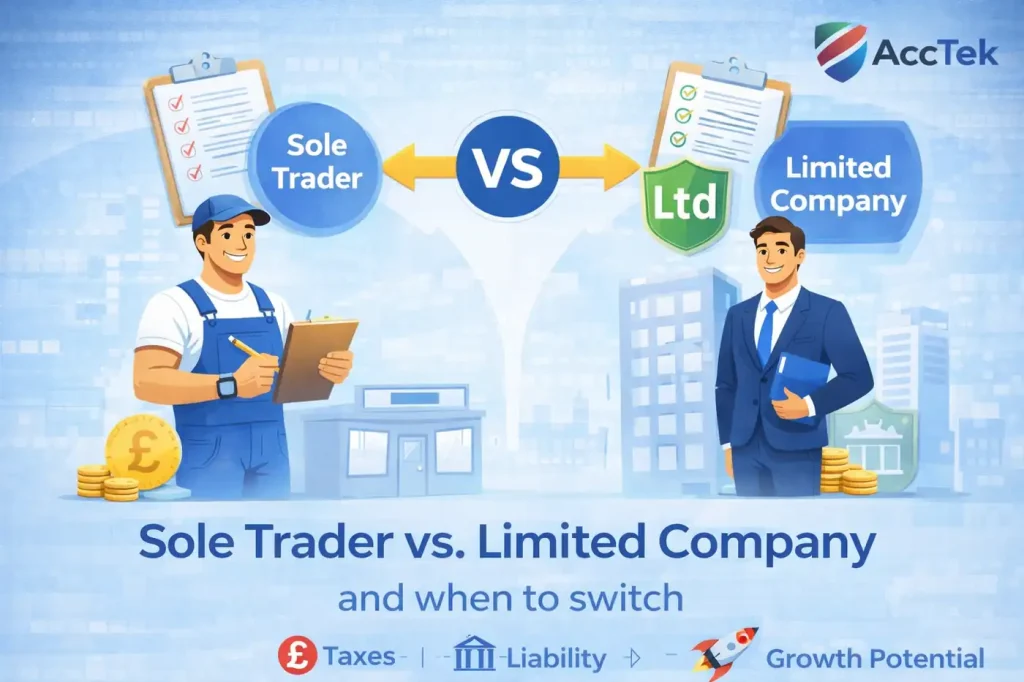
Welcome back! As your dedicated Chartered Accountant, I’ve seen many a sole trader look longingly at the “Ltd” suffix like it’s a shiny new sports car. But before you trade in your sole trader status, we need to look under the hood.
In the 2024/25 and 2025/26 tax years, the gap between these two has shifted thanks to changes in National Insurance and Corporation Tax. Let’s break down the “Why,” the “When,” and the “Wait, how much paperwork?”
| Feature | Sole Trader | Limited Company |
| Legal Status | You = The Business. | Separate legal entity. |
| Liability | Unlimited (your house is on the line). | Limited (usually only the company’s assets). |
| Tax Paid | Income Tax & Class 4 NICs. | Corporation Tax & Dividend Tax. |
| Privacy | High. Only HMRC sees your numbers. | Low. Accounts are public on Companies House. |
| Admin | Simple (Self Assessment). | Complex (Annual Accounts, CT600, Payroll). |
This is where the math gets fun (at least for me!).
For Sole Traders:
You pay 20% Income Tax and 6% Class 4 National Insurance (on profits between £12,570 and £50,270). Total “top slice” tax: 26%.
For Limited Companies:
The company pays 19% Corporation Tax (on profits up to £50,000). If you want that money personally, you then pay Dividend Tax (8.75% for basic rate).
Effective “double tax” rate: $1 – (0.81 X 0.9125) approx 26.1%
The Verdict: At the basic rate level, the tax gap has almost vanished! You no longer switch to a Limited Company just to save a few quid on tax at £30k profit.
If the tax savings aren’t as huge as they used to be, why switch? Here are the “Trigger Points”:
If you start taking on big contracts, hiring employees, or renting a shop, your risk increases. As a sole trader, if a client sues you for £100k and you don’t have it, they can come for your personal savings. A Limited Company provides a “corporate veil” that protects your personal stuff.
Some big corporate clients or government bodies simply won’t work with sole traders. If “The Pizza Wizard” needs to become “Pizza Wizard Ltd” to land that supermarket contract, it’s time to switch.
Once you cross into the Higher Rate tax bracket (£50,270), the flexibility of a company shines. You can keep profits inside the company, paying only 19-25% Corporation Tax, and wait to take them out in a later year when you might be in a lower tax bracket.
Before you rush to Companies House, remember that “Ltd” stands for “Lots of Tough Documents.”
Accountancy Fees: Expect to pay £1,000–£2,000+ per year (vs. £300–£600 for a sole trader).
Business Bank Account: A legal requirement for companies.
Making Tax Digital (MTD): Companies are already deep in digital filing, while sole traders have until April 2026 (for those over £50k income) to catch up.
Meet Maya. Maya is a consultant making £40,000 profit.
As a Sole Trader: She pays ~£7,100 in tax/NI. Total admin: 1 hour a month.
As a Limited Company: She pays ~£7,000 in combined taxes. Total admin: 5 hours a month + £1,200 in extra accountancy fees.
Maya’s Move: She stays a sole trader. The “savings” don’t cover the extra costs. However, once Maya hits £60,000 profit, her tax savings jump to nearly £2,500—now the switch makes sense!
Is your profit consistently over £50,000?
Does your business involve high financial risk?
Do you want to retain profit to invest back into the business?
Are you okay with your home address (or a registered office) being public?
If you answered “Yes” to at least three, let’s talk about incorporating!

Godwin Pinto ACA (ICAI) is the founder of AccTek and a member of ICPA, with 20+ years of experience in accounting and tax for contractors, startups and SMEs. Previously at PwC.
AccTek is a member firm of the Institute of Certified Practising Accountants (ICPA), and our founder is a member of the Association of International Accountants (AIA) holding an AIA Practising Certificate. Our accountants hold qualifications and accreditations from trusted professional bodies including the AIA, ICPA, AAT and ACCA.