SEIS and EIS are the two tax reliefs that most often decide whether a UK angel says yes to your seed round. If you are raising early-stage capital, understanding them is not optional — investors will ask about them before they read your deck. This guide explains how the Seed Enterprise Investment Scheme (SEIS) and the Enterprise Investment Scheme (EIS) work in 2026/27, what changed in April 2026, and how to structure your raise so the relief actually lands.
I am Godwin Pinto, an ACA (ICAI) chartered accountant and founder of AccTek. I have spent 20+ years advising contractors, SMEs and startup founders on exactly these decisions, so I have written this for founders raising money — not for investors, and not in tax-manual language.
SEIS and EIS are government-backed schemes that give investors generous tax relief for buying new shares in qualifying early-stage UK companies. The government subsidises part of the investor’s downside because early-stage companies are genuinely risky, which makes it far easier for a founder to attract angel capital. SEIS targets the very earliest companies; EIS covers slightly larger, scaling businesses. Many founders raise SEIS first, then follow with EIS once they have traction.
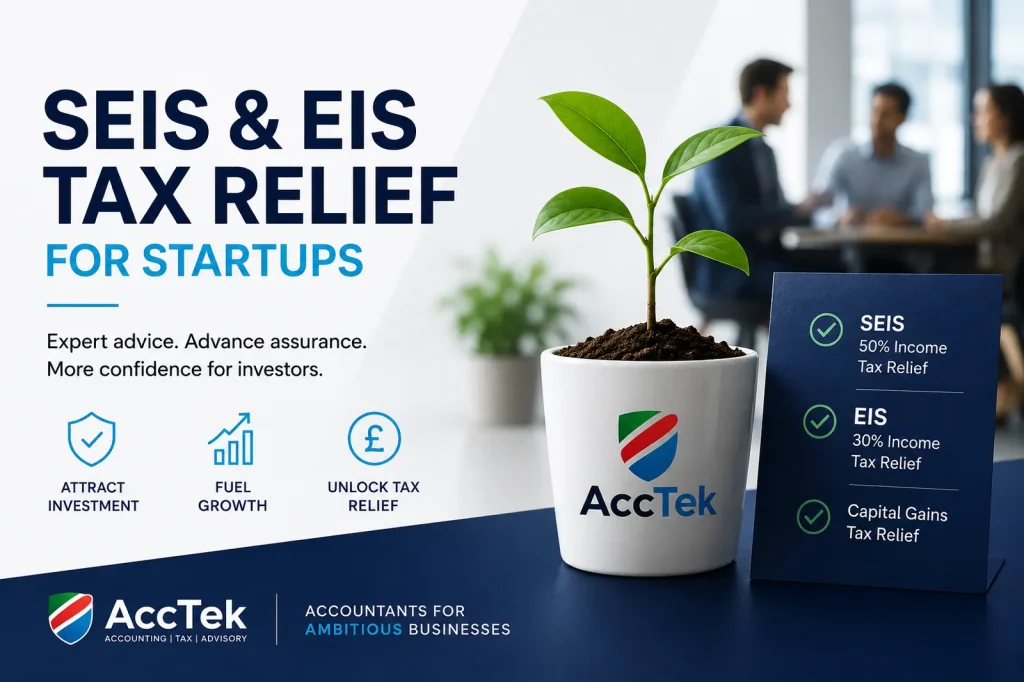
SEIS is deliberately narrow — it is aimed at pre-revenue or barely-revenue companies. The core figures are unchanged for 2026/27:
For the investor, SEIS also offers a 50% capital gains reinvestment exemption, a full CGT exemption on any gain if the shares are held at least three years, and loss relief if the company fails.
EIS picks up where SEIS leaves off, for companies that are scaling. From 6 April 2026 the company limits were significantly increased, so more growth-stage businesses now qualify:
EIS additionally offers unlimited CGT deferral (defer a gain from another asset by reinvesting it), CGT exemption after three years, and loss relief. The scheme has been extended to April 2035, so there is long-term certainty for planning a multi-round journey.
| SEIS | EIS | |
|---|---|---|
| Stage | Pre-revenue / earliest | Scaling / traction |
| Investor income tax relief | 50% | 30% |
| Investor annual limit | £200,000 | £1,000,000 (£2m KIC) |
| Company raise limit | £250,000 (lifetime SEIS) | £10m/yr, £24m lifetime |
| Company age | Under 3 years trading | Under 7 years (10 KIC) |
| Gross assets before | ≤ £350,000 | ≤ £30 million |
| Directors can invest? | Yes (under 30%) | Only non-controlling directors |
The sequencing rule matters: you cannot use SEIS and EIS in the same accounting period, and in a period where you use both, the SEIS shares must be issued before any EIS shares. In practice, most founders exhaust their £250,000 SEIS allowance first — because 50% relief is the strongest hook for angels — then move to EIS for the larger cheques.
You are not the one claiming the relief, but understanding the investor’s economics is your best negotiating tool. Take a 45% additional-rate angel investing £10,000 under SEIS: they receive £5,000 of income tax relief immediately. If your company later fails, loss relief on the remaining £5,000 at 45% recovers another £2,250 — so their real exposure is around £2,750, not £10,000. That is the case you are really making when you say “we’re SEIS eligible”: you are telling an angel the government has de-risked more than seven-tenths of their downside.
One 2026 change to flag honestly: the Inheritance Tax Business Relief that SEIS/EIS shares can attract after two years is now subject to a £1 million cap for 100% relief, with 50% relief above that, from April 2026. For most seed investors this is immaterial, but sophisticated angels may raise it.
Advance assurance is HMRC’s written confirmation that your proposed share issue is likely to qualify for SEIS or EIS. It is not a legal guarantee, but most angels expect to see it before they commit, so it is effectively a gate on your round. HMRC typically responds in around 4–6 weeks, so apply at least 8 weeks before your target close.
After shares are issued, you run the compliance step: before you can file, your company must either have been trading for four months or have spent at least 70% of the SEIS funds. You then file form SEIS1 (within two years of the share issue — miss it and your investors lose their relief), HMRC returns a SEIS2 authorisation, and you issue each investor a SEIS3 certificate they use to claim through Self Assessment. EIS follows the equivalent EIS1/EIS2/EIS3 route.
Getting SEIS/EIS right is mostly about preparation: a correctly structured company, clean accounts that reflect the trading position, and an advance assurance application that HMRC can approve first time. We handle the SEIS/EIS advance assurance and compliance end to end, and fold it into wider seed round finance prep so your data room, cap table and forecasts stand up to investor diligence. If you want the full picture of what investors will ask for, our fundraising finance guide walks through it, and once you are scaling, a fractional CFO can own investor reporting for you.
Yes, but not in the same accounting period, and where both are used in one period the SEIS shares must be issued before any EIS shares. Most founders raise their full £250,000 SEIS allowance first, then move to EIS.
HMRC typically responds in around 4–6 weeks. Apply at least 8 weeks before your target close so it does not hold up your round.
Yes. Directors can invest under SEIS and claim relief provided they hold no more than 30% of the shares, votes or rights to assets. Under EIS, controlling directors are excluded, but non-controlling directors can invest.
SEIS is unchanged for 2026/27. EIS company limits increased from 6 April 2026 — gross assets rose to £30m/£35m and the annual raise doubled to £10m (£20m for knowledge-intensive companies). EIS is now extended to April 2035.
You must file the SEIS1 compliance statement within two years of the share issue. Miss it and your investors can lose their income tax relief — which is a fast way to lose an angel’s goodwill. Diarise it the day shares are issued.
If you are approaching a seed round, get the structure and advance assurance right before you issue a single share. Get an instant quote and we will map out your SEIS/EIS path.
About the author. Godwin Pinto ACA is a chartered accountant and founder of AccTek with 20+ years’ experience advising contractors, SMEs and startup founders on tax-efficient structuring, fundraising and company formation. Connect on LinkedIn.
This article is general information for 2026/27, not tax or investment advice, and SEIS/EIS investments are high-risk and illiquid. Reliefs depend on individual and company circumstances and can be withdrawn if conditions are not met. Always take advice on your specific situation.

Godwin Pinto ACA (ICAI) is the founder of AccTek and a member of ICPA, with 20+ years of experience in accounting and tax for contractors, startups and SMEs. Previously at PwC.
AccTek is a member firm of the Institute of Certified Practising Accountants (ICPA). Our accountants have a wide range of qualifications and accreditations from trusted professional bodies such as the AAT, ICPA, and ACCA.