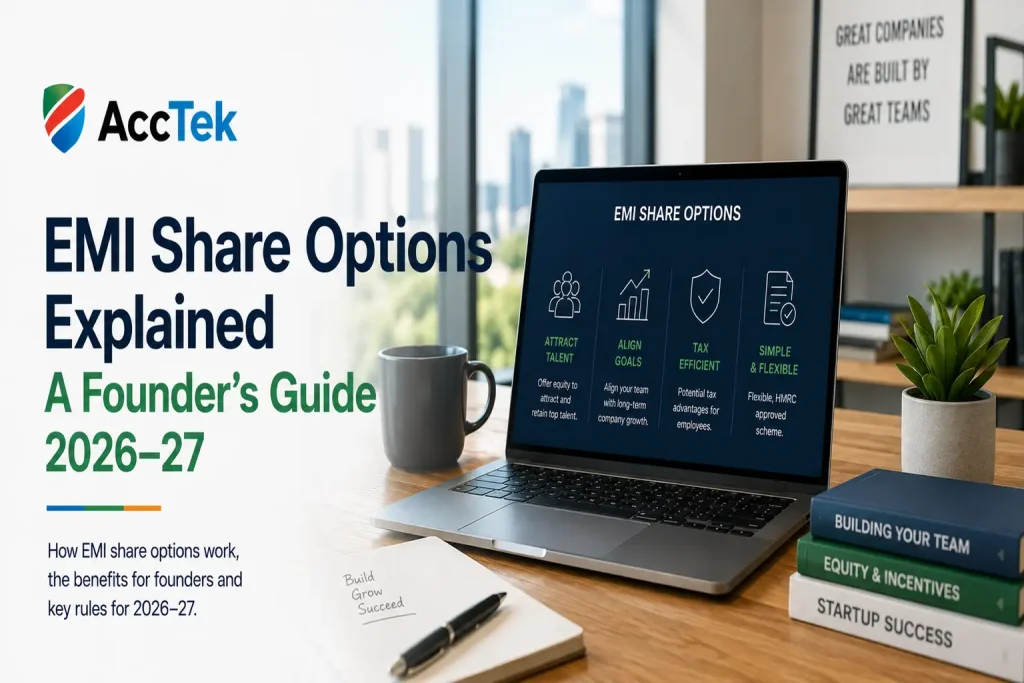
EMI share options are the most tax-efficient way for a UK company to give employees a real stake in the business — and from April 2026 far more companies can use them. If you are trying to hire and keep good people without burning cash on salary, Enterprise Management Incentives (EMI) are usually the first tool a founder should reach for. This guide explains how EMI works in 2026/27, what changed on 6 April 2026, how it is taxed, and the compliance steps that actually matter.
I am Godwin Pinto, an ACA (ICAI) chartered accountant and founder of AccTek. I have spent 20+ years helping founders and SME directors structure equity and reward, so this is written for employers setting up a scheme — in plain English.
An EMI scheme lets a qualifying company grant employees options to buy shares at a fixed price in the future, with generous tax treatment approved by HMRC. The employee pays nothing on grant and has nothing at risk until they choose to exercise — usually at an exit such as a trade sale. Because the price is fixed at grant, everyone gets certainty, and the employee keeps far more of the upside than they would with salary, a bonus, or unapproved options.
The appeal is simple: EMI aligns your team with the outcome you are all working towards, at almost no cash cost. Compared with a pay rise, there is no employer National Insurance on the option gain (a salary increase costs 15% employer NI above the £5,000 secondary threshold in 2026/27), the employee faces no income tax or NIC if options are granted at market value, and your company can claim a corporation tax deduction on the gain when options are exercised. For an early-stage business short on cash but long on potential, that is a rare win-win-win.
The Autumn Budget 2025 significantly widened EMI from 6 April 2026, so many scale-ups that had outgrown the scheme now qualify again:
If you were previously told “we’ve outgrown EMI, we can only offer CSOP or unapproved options now,” it is worth re-checking — the door may have reopened.
To grant EMI options, your company (or group) must, at the date of grant:
If there is any doubt, you can ask HMRC for advance assurance that the company qualifies before you grant.
A qualifying employee must spend at least 25 hours a week, or if less 75% of their working time, working for the company or group, and must give a written declaration confirming it. They also cannot have a material interest — broadly, more than 30% of the shares — at the time of grant. That last point matters for founder-directors: a controlling founder usually cannot grant EMI options to themselves.
| Stage | Tax treatment (2026/27) |
|---|---|
| On grant | No income tax or NIC. |
| On exercise | No income tax or NIC, provided the exercise price is at least the market value agreed with HMRC at grant. If granted at a discount, income tax applies to the discount. |
| On sale of shares | Capital Gains Tax at 24% — or 18% under Business Asset Disposal Relief (BADR) on the first £1 million of lifetime gains, if held at least 24 months from the grant date. |
| For the company | Corporation tax deduction on the option gain (market value at exercise minus the exercise price). |
Two EMI-specific perks make BADR unusually generous here: the normal 5% shareholding requirement is waived, and the two-year clock runs from the date of grant, not exercise — so employees can often qualify for the 18% rate. Note the BADR rate rose to 18% from 6 April 2026 (it was 14% in 2025/26).
EMI is generous, but the tax advantages are lost if you get the admin wrong. In order:
Good news on the horizon: from April 2027 the separate per-grant notification requirement is being abolished, though the annual ERS return will remain. Until then, calendar the 6 July deadline the day you grant — HMRC gives little leeway on late notifications.
Getting EMI right is about sequencing: confirm the company qualifies, agree the valuation with HMRC, get clean agreements in place, and never miss the ERS deadline. We handle the setup and ongoing compliance end to end as part of the wider support a specialist startup accountant provides, alongside director pay planning and, once you are scaling, a fractional CFO to own reward and reporting.
From 6 April 2026 the company option limit doubled to £6 million, the gross assets limit rose to £120 million, the employee limit rose to fewer than 500, and the option exercise period extended to 15 years. The £250,000 individual limit is unchanged.
Up to £250,000 of shares, valued at the date of grant, per employee. Any options under a Company Share Option Plan (CSOP) count towards this limit.
No income tax or NIC on grant, and none on exercise if the exercise price is at least the market value agreed with HMRC at grant. On sale, Capital Gains Tax applies — 24%, or 18% under Business Asset Disposal Relief if held two years from grant.
For options granted on or after 6 April 2024, you must notify HMRC through the ERS service by 6 July following the end of the tax year of grant. Missing it is a disqualifying event. This per-grant notification is due to be abolished from April 2027.
Only if they do not have a material interest — broadly, no more than 30% of the shares — at the time of grant. A controlling founder usually cannot, though other qualifying employees and directors can.
Thinking about giving your team equity? Get the valuation, agreements and HMRC notifications right from the start. Get an instant quote and we will help you design and run your EMI scheme.
About the author. Godwin Pinto ACA is a chartered accountant and founder of AccTek with 20+ years’ experience advising contractors, SMEs and startup founders on tax-efficient structuring, equity and reward. Connect on LinkedIn.
This article is general information for 2026/27, not tax or legal advice. EMI eligibility and tax treatment depend on individual and company circumstances and can change. Always take advice on your specific situation before granting options.

Godwin Pinto ACA (ICAI) is the founder of AccTek and a member of ICPA, with 20+ years of experience in accounting and tax for contractors, startups and SMEs. Previously at PwC.
AccTek is a member firm of the Institute of Certified Practising Accountants (ICPA). Our accountants have a wide range of qualifications and accreditations from trusted professional bodies such as the AAT, ICPA, and ACCA.