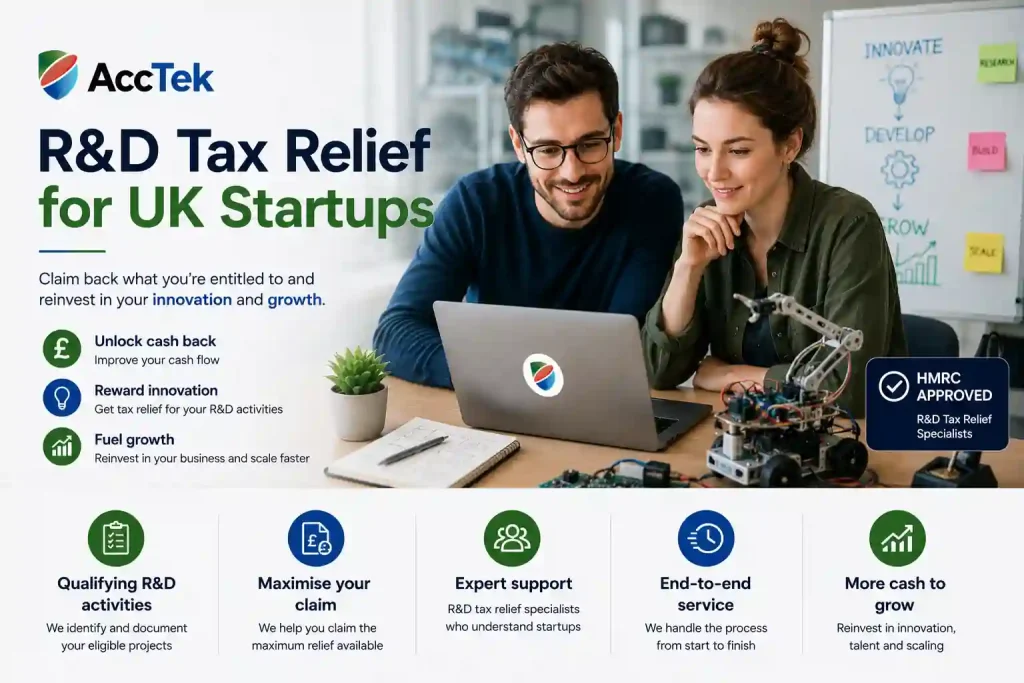
R&D tax credits let UK companies reclaim a slice of what they spend developing new products, processes and software — either as a cut to their Corporation Tax bill or as cash. For a startup or SME investing in genuine innovation, it is one of the most valuable reliefs available. But the rules were overhauled from April 2024, and the way most founders remember the scheme is now out of date. This guide explains how R&D tax credits work in 2026/27, whether you qualify, and the compliance traps that sink otherwise-valid claims.
I am Godwin Pinto, an ACA (ICAI) chartered accountant and founder of AccTek. I have spent 20+ years helping founders and SME directors claim reliefs like this without falling foul of HMRC, so this is written in plain English for the person running the business.
R&D tax credits are a Corporation Tax relief that rewards companies for work seeking a genuine advance in science or technology. If your team is resolving technical uncertainty that a competent professional could not easily work out — not just applying known techniques — the cost of that work can attract relief. Profitable companies use it to reduce their tax bill; loss-making companies can often take it as a cash payment, which is why it matters so much for early-stage businesses burning through runway.
This is the part that trips people up. For accounting periods beginning on or after 1 April 2024, the old separate SME and RDEC schemes were replaced by a single Merged Scheme R&D Expenditure Credit (RDEC):
The headline for most SMEs is blunt: the merged scheme is less generous than the old SME regime. That is exactly why the exception below matters.
If you are a loss-making SME that spends heavily on R&D, you may qualify for Enhanced R&D Intensive Support (ERIS) instead — which is far more generous:
For a research-heavy pre-revenue startup, ERIS can be the difference between a 15% and a 27% return on R&D spend — so working out which scheme you fall into is the single most valuable decision in the whole process.
This is where most rejected claims fail. Qualifying R&D must seek an advance in a field of science or technology and resolve scientific or technological uncertainty. In practice that means:
Once a project qualifies, you can typically include staff costs (salary, employer NIC, pension), a proportion of subcontractor and externally provided worker costs, consumables used up in the R&D, software, and data and cloud-computing costs. Two April 2024 changes matter here:
HMRC has tightened R&D compliance significantly, and most lost claims are lost on process, not substance:
A good R&D claim is equal parts tax and technical storytelling: identifying which projects qualify, working out the right scheme, calculating the credit, and writing an AIF that stands up to scrutiny. We handle that end to end as part of the wider support a specialist startup accountant provides — and R&D relief usually sits alongside other founder reliefs like SEIS and EIS for your investors and EMI share options for your team.
Under the merged RDEC scheme the credit is 20% of qualifying spend, worth around 15p per £1 after Corporation Tax. Loss-making R&D-intensive SMEs claiming under ERIS can receive around 27p per £1 as a cash credit.
Work that seeks an advance in science or technology and resolves genuine scientific or technological uncertainty that a competent professional could not readily work out. Routine development, configuration and cosmetic changes do not qualify.
Yes. Loss-making companies can usually take the credit as cash, subject to a PAYE/NIC cap. If at least 30% of your total spend is on qualifying R&D, ERIS gives a more generous cash credit of around 27p per £1.
If you are a new claimant, or have not claimed in the previous three years, you must submit a claim notification within 6 months of the end of the accounting period. Miss it and you lose the right to claim for that period. All claimants must also file an Additional Information Form.
Yes. From April 2024 the old subsidised-expenditure restriction was removed, so grant-funded R&D is now claimable under the merged scheme and ERIS.
If your company is building something genuinely new, there is a good chance you are leaving R&D relief unclaimed — or claiming it in a way that risks an enquiry. Get an instant quote and we will review whether, and how, you should be claiming.
About the author. Godwin Pinto ACA is a chartered accountant and founder of AccTek with 20+ years’ experience advising founders and SME directors on Corporation Tax, R&D relief and tax-efficient structuring. Connect on LinkedIn.
This article is general information for 2026/27, not tax advice. R&D eligibility and rates depend on individual company circumstances and can change. Always take advice on your specific claim before submitting it to HMRC.

Godwin Pinto ACA (ICAI) is the founder of AccTek and a member of ICPA, with 20+ years of experience in accounting and tax for contractors, startups and SMEs. Previously at PwC.
AccTek is a member firm of the Institute of Certified Practising Accountants (ICPA), and our founder is a member of the Association of International Accountants (AIA) holding an AIA Practising Certificate. Our accountants hold qualifications and accreditations from trusted professional bodies including the AIA, ICPA, AAT and ACCA.