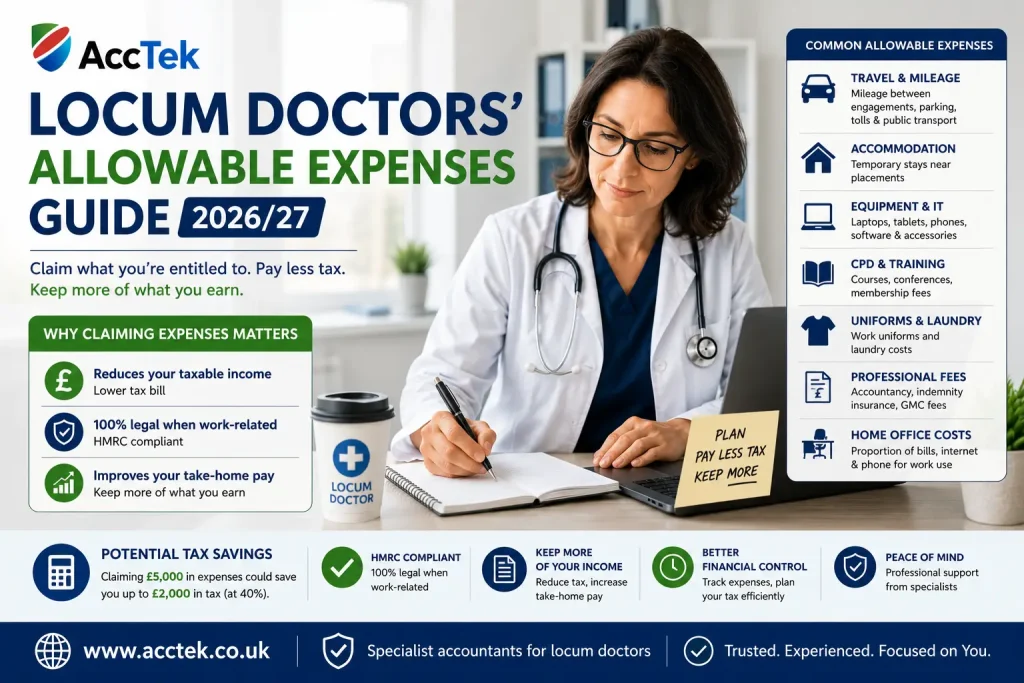
Hello, wonderful healthcare heroes! 🩺
As a qualified Chartered Accountant, I spend my days staring at spreadsheets so you don’t have to. While you are out there saving lives, diagnosing mysterious rashes, and downing lukewarm coffee between patient consultations, there is a silent baseline pulse you might be ignoring: your tax return.
If you operate as a self-employed locum doctor, you aren’t just a clinician; you are a business owner. And just like any business, the UK tax system allows you to deduct certain expenses from your income before calculating how much tax you owe.
But what exactly is “allowable”? How do you navigate the maze of the His Majesty’s Revenue and Customs (HMRC) guidelines without breaking out in hives? Let’s break it down using real-world scenarios, clear tables, and some incredibly exciting recent tax updates for the current 2026/27 tax year and looking ahead to 2027/28.
Before we look at specific items, we must address HMRC’s ultimate mantra. For an expense to be legally offset against your profits, it must be incurred “wholly and exclusively” for the purposes of your trade.
Dr. Sarah is an independent locum GP. She drives to three different surgeries across London every week. She also uses her car to drive to the supermarket on weekends.
Can she claim the entire cost of running her car? Absolutely not. That violates the “wholly and exclusively” rule because of the private weekend use.
What can she do? She can apportion her costs. If 60% of her annual mileage is spent driving between temporary locum assignments, she can claim 60% of her actual car expenses—or better yet, use HMRC’s simplified mileage allowance.
If you’ve been using the standard HMRC flat-rate mileage method, you’ll know that the rates have been frozen in time since 2011. But there’s fantastic news! Following a Treasury announcement, approved mileage rates have officially increased for the current 2026/27 tax year (and will carry forward into 2027/28).
For the first 10,000 business miles driven in a tax year, the rate has jumped from 45p to 55p per mile.
Let’s look at how much this saves Dr. Sarah if she clocks 8,000 business miles this year:
Old Rate calculation: 8,000 miles x 45p = £3,600
New 2026/27 Rate calculation: 8,000 miles x 55p = £4,400
That is an extra £800 in tax-free deductions just for keeping an accurate mileage log!
| Vehicle Type | First 10,000 Business Miles (2026/27 & 2027/28) | Over 10,000 Business Miles |
| Cars and Vans | 55p (Up from 45p!) | 25p |
| Motorcycles | 24p | 24p |
| Bicycles | 20p | 20p |
Note: You can read the official confirmation on the HMRC Agent Update page.
What else can you write off? Let’s check the items that keep your business running smoothly. You can cross-reference these with the official HMRC Doctors’ Expenses Help Sheet (HS231).
Good news here! HMRC maintains a list of approved professional bodies. If membership is required to practice, it’s deductible.
GMC Retention Fees: Yes.
BMA Subscriptions: Yes.
Medical Indemnity Insurance (MDU / MPS): Yes, completely allowable and absolutely essential!
Royal College Memberships: Yes, provided it relates directly to your current practice.
This is a notorious grey area that gets many doctors into hot water. The rule of thumb is maintenance vs. new skills.
Allowable: Upgrading or maintaining your existing clinical skills. For example, attending a seminar on the latest diabetes management guidelines or paying for your mandatory GMC revalidation process (fully supported under HMRC Business Income Manual BIM54040).
NOT Allowable: Training to acquire a completely new qualification that changes the nature of what you do (e.g., an MBA or learning a completely separate medical specialty from scratch).
If you buy tools required for your daily work, they are tax-deductible.
Equipment: Stethoscopes, blood pressure cuffs, ophthalmoscopes, and even your medical bag. For larger purchases (like a high-end ultrasound machine), you will claim this via Capital Allowances.
Clothing: You cannot claim for a nice smart jacket to wear at the clinic (HMRC argues it has a “dual purpose” of keeping you warm and decent). However, clinical scrubs, theatre shoes, and protective clothing are fully deductible, along with the cost of laundering them.
Even if you work on the move, you still do your billing, book shifts, and complete CPD at home.
Use of Home: You can claim a proportion of your household utility bills based on the rooms you use for business, or use the HMRC Simplified Expense flat rate (ranging from £10 to £26 per month depending on the hours you work from home).
Phone & Broadband: If you use your personal mobile phone to speak with agencies or clinics, you can claim the business percentage of your contract.
| Expense Item | Tax-Deductible? | The HMRC Verdict |
| GMC & Indemnity Fees | ✅ YES | Essential professional requirements. |
| Scrubs & Laundry | ✅ YES | Classed as specialist/protective clothing. |
| Commuting to a regular practice | ❌ NO | Commuting to a single “permanent” place of work is private travel. |
| Travelling to various ad-hoc clinics | ✅ YES | Temporary workplaces count as business travel. |
| Lunches on a normal shift | ❌ NO | You have to eat to live, regardless of your work! (Unless on overnight business travel). |
| Accountancy Fees | ✅ YES | The cost of preparing your business accounts is fully allowable. |
If we look at a typical self-employed locum doctor earning £100,000 gross a year, their expenses often follow a predictable breakdown. Maxing out these categories legally shrinks your taxable profit margin, keeping more cash in your pocket.
[Typical Locum Doctor Expense Allocation]

 📈 Travel & Mileage (Thanks to the new 55p rate!) [███████████████] 40%
 🛡️ Medical Indemnity & Professional Fees        [████████████] 30%
 📚 CPD, Revalidation & Courses                  [████████] 20%
 💻 Equipment, Tech & Use of Home                [████] 10%
(Graph shows the approximate proportion of total business expenses claimed by an average independent locum doctor)
Let’s look at Dr. Raj. Raj threw all his equipment and training receipts into a drawer… which his toddler subsequently used as an art canvas. When filing his tax return for the 2026/27 tax year (due by 31 January 2028 if filing online), Raj estimated he spent £2,000 on courses and books but had zero digital or physical proof.
If HMRC decides to check Raj’s return, they can disallow any expense that lacks a digital trail or receipt. As a higher-rate taxpayer (40%), losing that £2,000 deduction means Raj would effectively face an extra £800 tax bill, plus potential interest and penalties!
The Accountant’s Remedy: Download a receipt-scanning app today. Every time you buy a piece of medical kit or pay a subscription, snap it, log it, and back it up to the cloud.
Tax doesn’t have to be a headache if you stay on top of it. With the 2026/27 and 2027/28 tax years bringing a highly lucrative bump to vehicle mileage claims, it pays more than ever to log your journeys accurately.
If you earn more than £100k per tax year then claiming these expenses save even more tax.
Make sure you keep clear records and reference the HMRC self-employed expenses guide whenever you are unsure. And remember: when your accounts get overly complex, don’t hesitate to refer your case to a qualified Chartered Accountant. For a deeper look at the pitfalls, read our guide on common tax mistakes made by doctors. We love treating financial ailments!
Need specialist help with your locum doctor tax?
AccTek’s specialist locum doctor accountant service handles everything from Self Assessment to NHS pension reviews — fixed fees from £19.99/month.
Related reading:
Disclaimer: This blog post is for informational and entertainment purposes only. Tax circumstances vary individually, so always consult a professional accountant or check current live GOV.UK guidance before making definitive financial claims.
For the full picture of how locum income is taxed in 2026/27 — National Insurance, the NHS pension annual allowance, Self Assessment deadlines and Making Tax Digital — see our locum doctor tax guide for 2026/27.

Godwin Pinto ACA (ICAI) is the founder of AccTek and a member of ICPA, with 20+ years of experience in accounting and tax for contractors, startups and SMEs. Previously at PwC.
Last updated: 6 August 2026


AccTek is a member firm of the Institute of Certified Practising Accountants (ICPA), and our founder is a member of the Association of International Accountants (AIA) holding an AIA Practising Certificate. Our accountants hold qualifications and accreditations from trusted professional bodies including the AIA, ICPA, AAT and ACCA.